


Source: https://www.kuka.com/en-us/industries/solutions-database/2025/12/automating-solar-panel-installation
Amidst a shortage of installers, increasingly heavy panels that can weigh 80 pounds and solar farms with hundreds of thousands of panels, robots are cutting labor costs and increasing speed. While they started out on solar farms, they’re now even going onto rooftops.
Robotics Power Solar Farm Installation
When we look at vast solar fields with thousands of solar panels, we often don’t think about what it took to put those panels in place. Behind the scenes, though, dozens of workers lifted the panels onto carriers, took them to the racks that hold them, lifted them onto the racks, and then fastened them in place. Physical demands are high, and finding enough workers is challenging. Robots are solving the key issues.
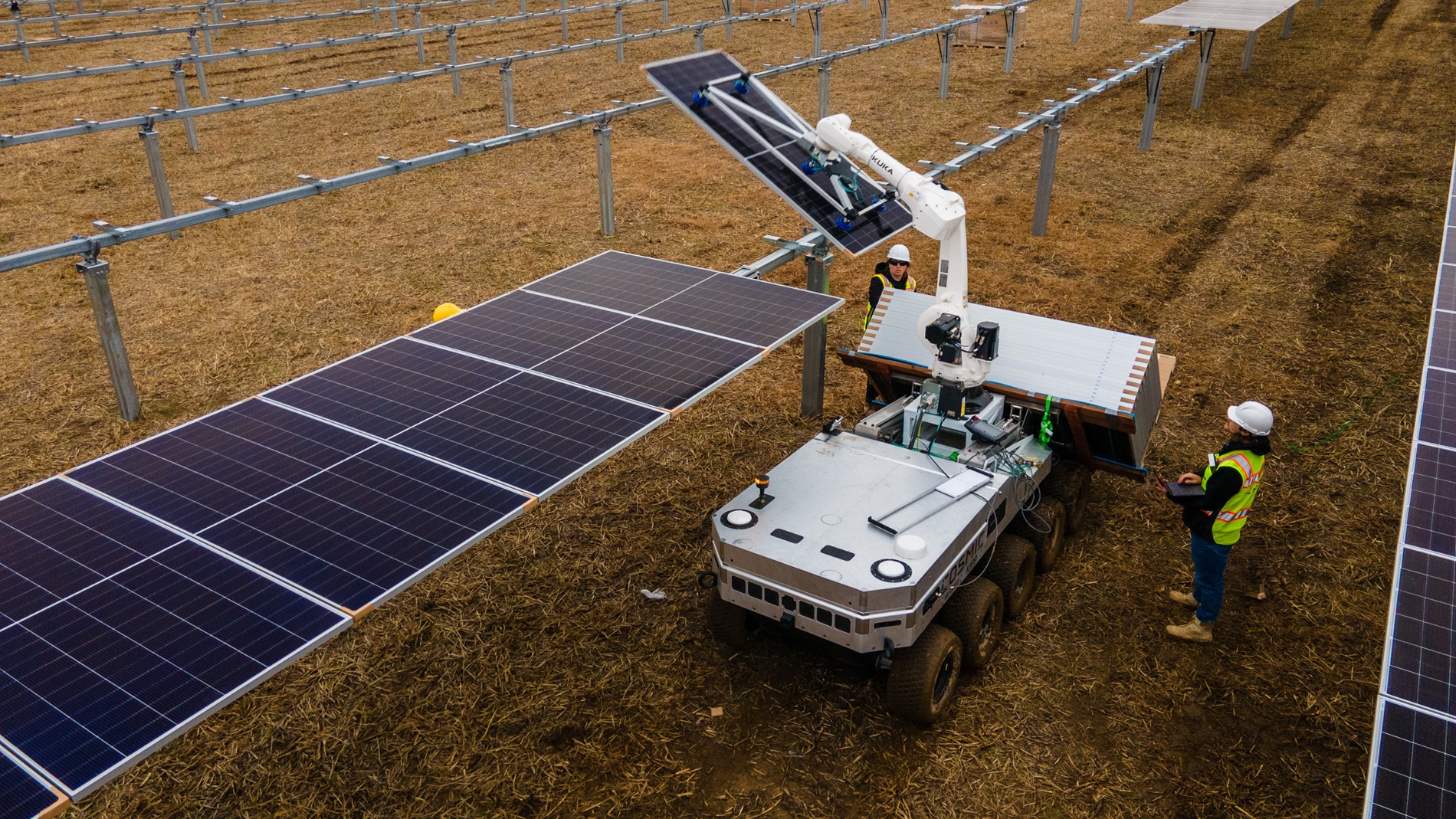
Here in the United States, for example, California-based Sunstall constructs massive solar energy farms that range from 1 megawatt to gigawatts. Installation crews have five or more people. Sunstall partnered with Cosmic Robotics, which produces electric robots with an all-terrain vehicle platform and a large KUKA robot arm for lifting panels. While workers still need to set up the racking that holds the panels, the robot eliminates the physically challenging work of lifting the panels into position and placing them on the frames.
Source: https://www.aes.com/energy-insights/reimagining-solar
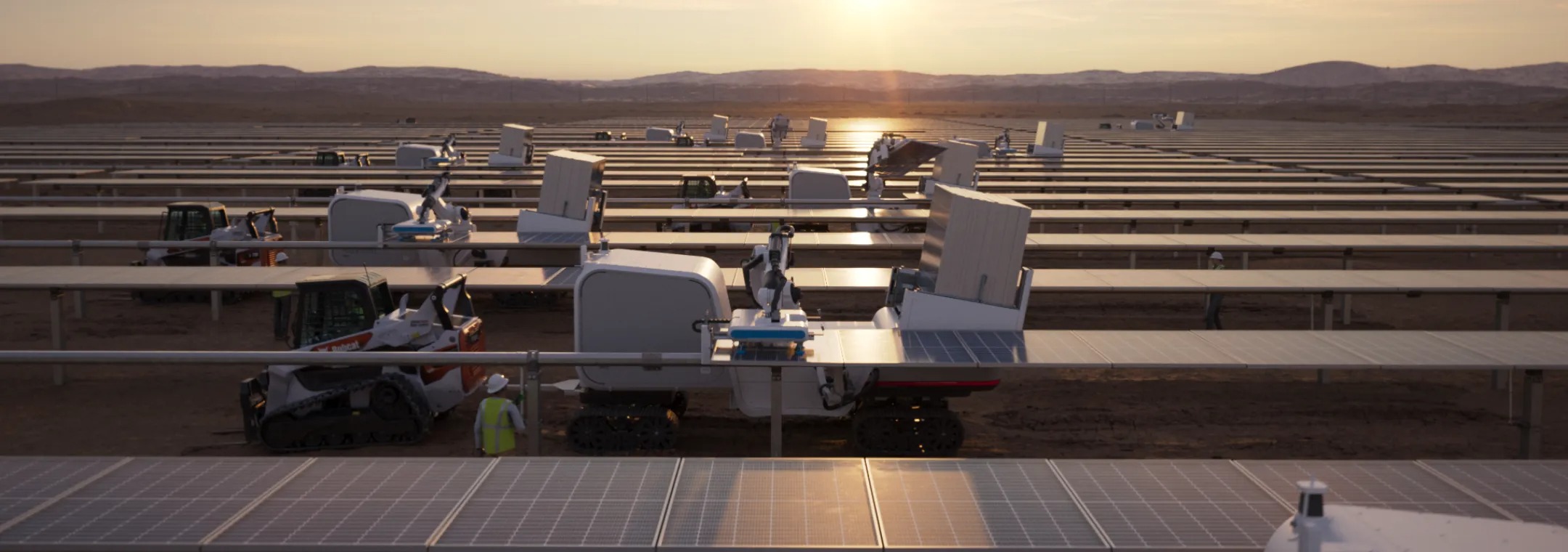
Over in Australia, Massachusetts-based Luminous Robotics is using robots to help construct a 250-megawatt solar power facility that will have nearly 600,000 solar panels. “LUMI is exceeding target production rate at 103 percent,” CEO Jay Wong wrote, “with key data and flow insights to increase capacity towards 246 percent.” The robots reduce costs and speed up installation. They also require skilled technicians to operate them, leading to upskilling the renewable energy workforce and enabling higher productivity.
Admittedly, the use of robots is not totally new. Way back in 2013, the New York Times reported that Alion Energy’s Rover was lifting 45-pound solar panels and installing them. Its companion, Spot, moved along rows of panels to wash away grit and squeegee them dry.
For solar professionals, the combination of devices and AI will enable them to do far more with less, improving their output and their bottom line. Moreover, smaller installers can compete more effectively.
Going Beyond Heavy Lifting
Now, companies are going beyond using robots just to transport the panels. They are developing plug-and-play modular solutions that make installation far easier and faster.
Even before solar panels are installed, for instance, Terabase Energy’s assessment and design solution models earthwork requirements and streamlines permitting processes, which greatly reduces engineering hours. Its robotics-assisted digital field factory for solar power plant construction enables faster installation.
5B in Australia similarly simplifies solar farm construction with prefabricated, pre-wired, 90-module ground mount blocks that crews can easily deploy and install in the field. Module assembly, cabling, connections and testing are done in its factory rather than in the field.
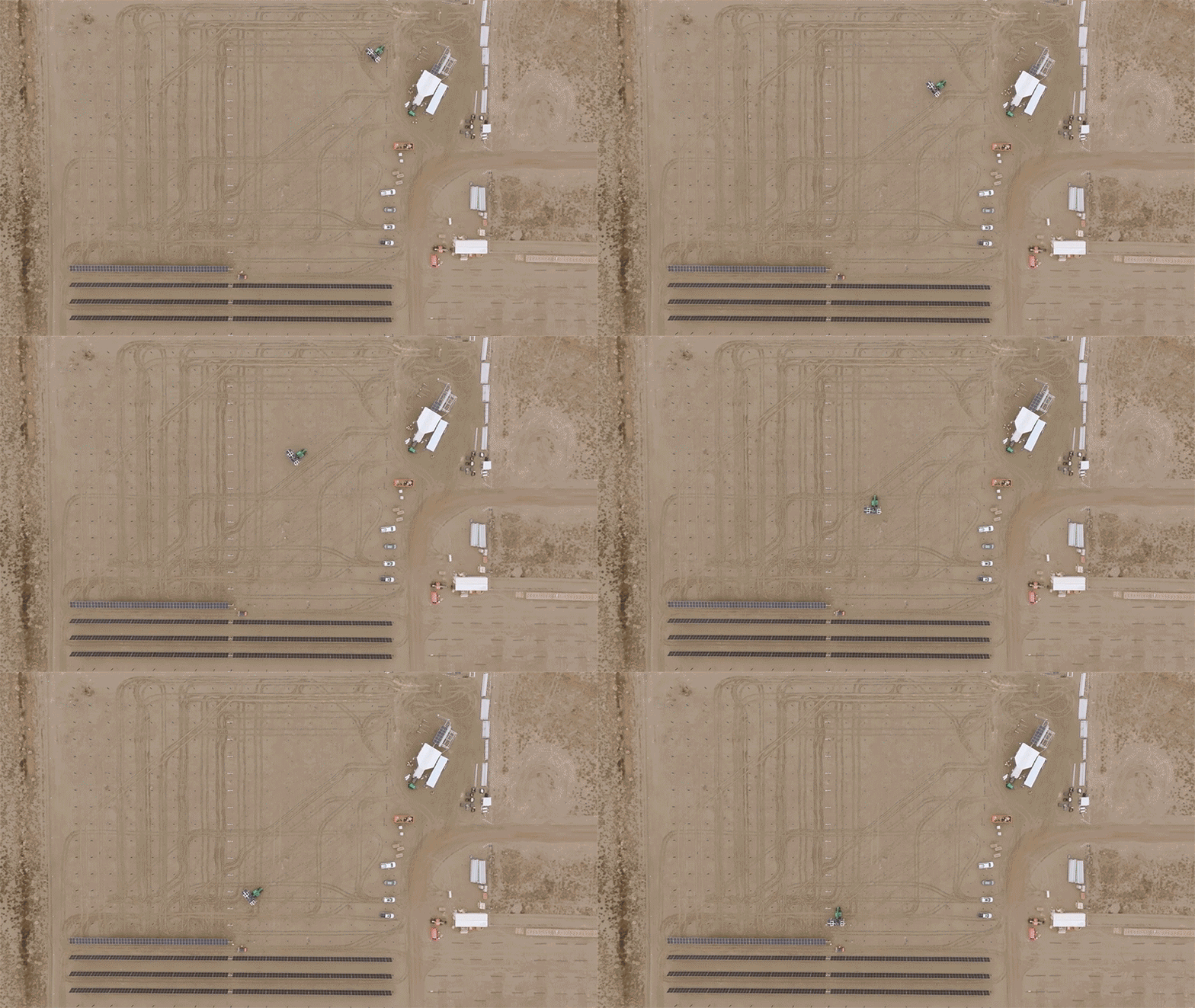
And Charge Robotics in California ships small factories to the site of utility solar projects, where equipment including tracks, mounting brackets, and panels are fed into the system and automatically assembled. Additionally, according to MIT News, a robotic vehicle autonomously puts the finished products in their final place.
While the robots for hauling and lifting panels make installation easier, prefabrication has the potential to transform the industry by further reducing the need for scarce labor and cutting costs even more.
Source: https://news.mit.edu/2025/charge-robotics-makes-solar-projects-cheaper-faster-portable-factories-0312
Robots are Moving to Rooftops
Whereas installing panels on a solar farm involves putting panels on racks largely in straight lines, installing solar panels on rooftops is more complex. Rooftops come in variations of size, shape and steepness. Despite the complexity, a small number of companies – primarily outside the US, for now – have developed robots that can put solar panels on rooftops.
In Thailand, for example, Solar D Corporation recently launched a robot which can install 1 megawatt of solar panels in just six days, making it 10 times faster than human workers and using just half the usual workforce. The robot’s accuracy and efficiency also reduce waste and minimize damage to the roof.
Trinabot in China is also focusing on rooftop solar. Its solar panel-laying robot, designed for residential and commercial as well as industrial rooftops, combines advanced robotics, AI and real-time sensor data to automate panel transportation, alignment and placement. Human operators only have to collaborate with the system to finalize installations so they can ensure precision and safety.
Although innovations for rooftop solar have started outside the US, they have the potential to reach the US soon and automate rooftop installation to the level of solar arrays.
Robots do more than Install Panels
And robots are now used to do more than just installing solar panels.
France’s AX Solar Robot, for instance, has developed a robotic cleaning solution for solar panels, according to PV Magazine. The system is designed for steep roofs in heavily polluted environments that require frequent cleaning, such as cement plants or flour mills, where dust can reduce PV panel efficiency by up to 50 percent in a week. The robot can handle roof slopes from 8° to 50°. It uses gravity to lower the cleaning unit, while solar panels power the brushes and lifting mechanism.
Robots are also being used to predict maintenance needs for solar arrays. Drones or ground-based robots with sensors can use algorithms and AI to find problems such as wiring defects or tiny cracks before they become a large problem and create downtime.
Companies that have installed solar are now able to reduce their costs further and avoid downtime that can hurt production or productivity.
Increasing Efficiency
While robots cannot install solar panels autonomously yet, they are doing the tasks that slowed projects and strained crews. As AI and devices improve, robots seem likely to make installation faster, safer, cheaper and easier so that solar energy is even more competitive than traditional energy sources.
Showing 1 reaction