


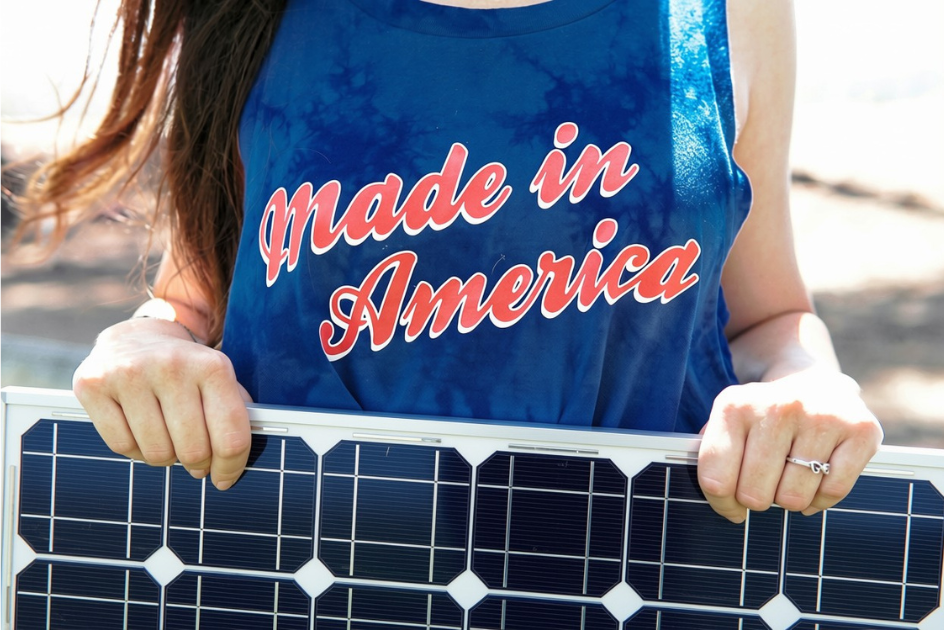
Every component for solar energy installations can now be made in the US, and production is continuing to expand. Many parts still come from overseas, however, so anyone installing solar needs to evaluate the products carefully if they want a fully American-made system.
Solar Panels and Components can be Made in the US
Every major component in the solar supply chain can now be made in America, according to the Solar Energy Industries Association (SEIA). 146 new solar and storage manufacturing facilities have begun production since 2022, and 36 more facilities are under construction. The US now has 70 GW of domestic solar module manufacturing capacity available, which is enough to meet all the demand for solar in the country.
Since 2022, Clean Technica added, the US solar and storage industry has announced more than $43 billion in manufacturing investments across more than 40 states. Moreover, the US ranks 3rd globally for solar panel production.
To show where the facilities are located, the US Department of Energy (DoE) has produced a US Solar Photovoltaic Manufacturing Map of active manufacturing sites in the solar photovoltaic (PV) supply chain.
One example is CS PowerTech, a subsidiary of Canadian Solar, which opened a manufacturing facility in Indiana in July 2026. The Courier Junction said the facility will produce "heterojunction bifacial N-type solar cells" which have higher efficiency and may produce more energy from smaller areas. It is the first US facility designed to produce this specific type of solar cell. At full capacity, the facility is expected to produce 6 gigawatts (GW) annually.
In addition to the solar energy system benefits, more production also increases jobs. The American Clean Power Association calculated that total employment impact in clean energy manufacturing is 215,700 jobs, with 106,100 in solar manufacturing, 53,100 from energy storage manufacturing and 56,500 from wind. By 2030, the ACPA expects an increase of more than 63,000 jobs in solar manufacturing and annual solar module production capability is expected to ramp up to more than 85 GW.
The Supply of Components is Insufficient
Amidst all that good news about the technical ability to manufacture all the components, Manufacturing Dive noted that there is still not enough production to meet all of the current domestic demand.
In addition to solar cells, solar energy installation requires a variety of other components. DoE explained that solar manufacturing refers to the fabrication and assembly of materials across the solar value chain. Solar PV modules include subcomponents such as wafers, cells, encapsulant, glass, backsheets, junction boxes, connectors and frames. Other components needed for solar energy systems include inverters, wiring, combiner boxes, racking and tracking structures.
Wood MacKenzie found that the US still has only 3 GW of cell manufacturing capacity, for instance, which leaves factories in the US heavily dependent on imported cells. While several new cell facilities are in development, it said uncertainty around US Foreign Entity of Concern (FEOC) requirements has hindered further investment decisions. Additionally, the Department of Commerce announced high preliminary countervailing duty and anti-dumping tariff rates on solar cells and modules from India, Indonesia, and Laos in the spring of 2026. Together with Malaysia, Thailand, and Vietnam, which are already subject to tariffs, these nations supplied 78 percent of cell imports last year. The result, Wood McKenzie concluded, is that the industry faces a more complicated trade environment than at any point in recent years.

Expanding upon that research, PV Magazine said most of the new domestic manufacturing additions in the United States in 2023 and 2024 came from crystalline silicon (c-Si) module factories, mainly due to the lower barrier to entry for module assembly compared to building a new cell factory. While new companies did enter the market, the US market was still being supplied in high volumes by imported modules. These imports resulted in slower progress for new module capacity in the US and largely removed the urgency to set up new c-Si cell facilities.
PV Magazine said also that although $43.1 billion is the announced domestic manufacturing investments since 2022, actual output is far lower. In reality, only $14.5 billion represents operational facilities. The rest is still tied up in development.
Installers and Homeowners need to Choose Carefully
Given the complexity of the manufacturing situation and the tariff or trade rules, installers and homeowners need to evaluate the situation carefully if they want a solar energy system that is made in America.
As Greenlancer explains it, the real question goes beyond where solar panels are made. Their Guide explains what US solar panel manufacturers are building, how American manufacturers fit into domestic content rules and where FEOC requirements affect project eligibility. Considerations for whether a specific module qualifies for tax credits and whether it passes sourcing rules as “American-made” include:
-
Assembled in USA: Final panel assembly happened at a US facility.
-
Made with US cells: The PV cells came from a US factory.
-
Domestic content compliant: The panel meets IRS cost percentage rules for the domestic content bonus that can include tax incentives.
-
FEOC and PFE compliant: The panel passes prohibited foreign entity rules.
-
Fully domestic: Polysilicon, ingot, wafer, cell, and module production are all US-based.
A module can come off a US assembly line and still miss domestic content thresholds or FEOC requirements.
Excellent Progress and More to Do
The solar manufacturing industry in the US has indeed made significant progress. Much more still needs to be done, though, for it to supply the full scope of demand for materials for solar energy systems in the country. And installers as well as homeowners need to understand more about panel and component production if they want American-made systems.
Showing 1 reaction