


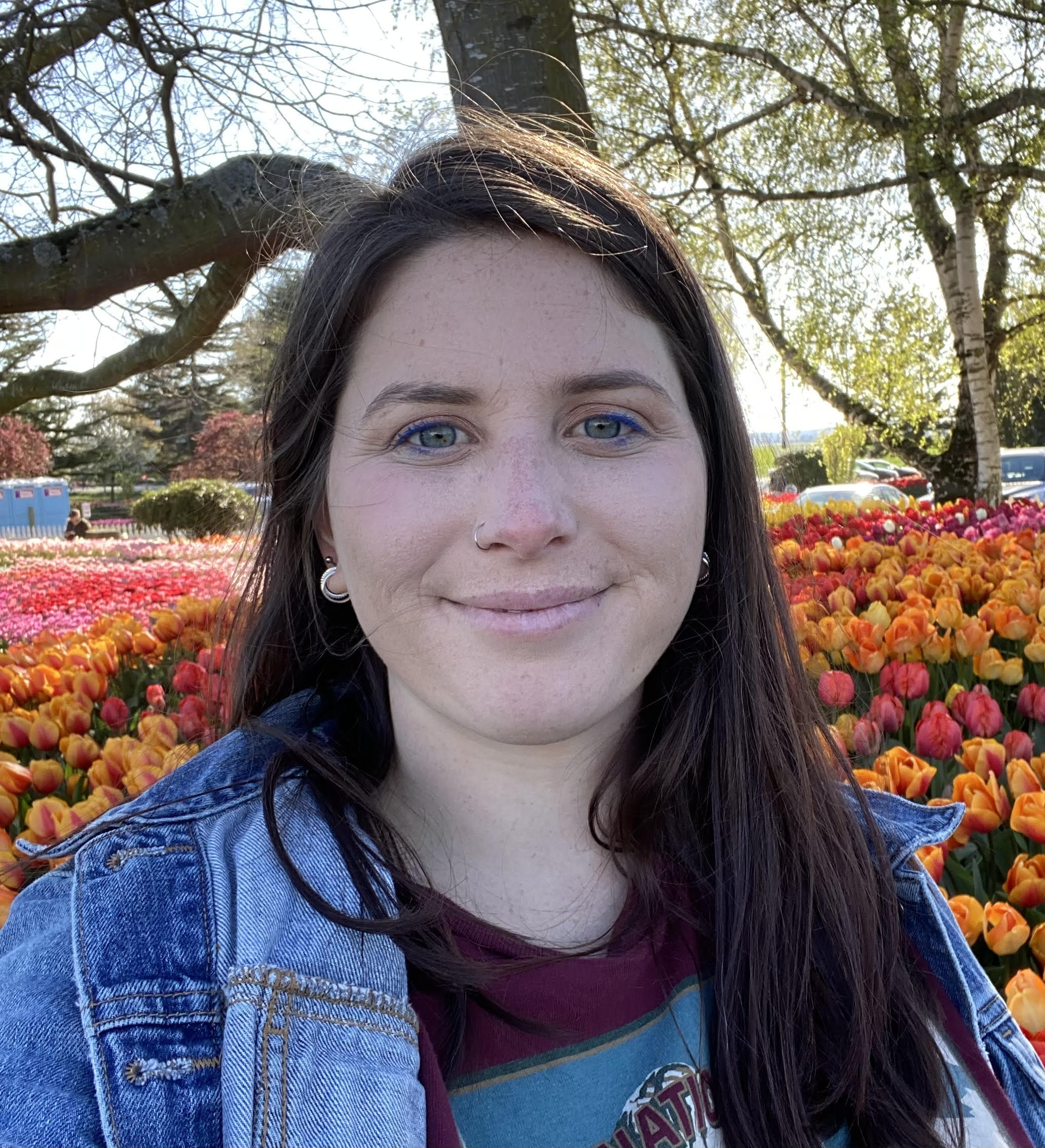
We interviewed new Solar Washington board member Rachel Gates about her experiences with solar and the solar industry.
Solar Washington: When, how, and/or why did you become interested in solar?
Rachel Gates: I think my first experience truly working on a solar project was earlier this year in my job. I managed a solar and battery energy storage system project for the Port Gambles S’Klallam Tribe’s clinic. And throughout that process, I learned a lot about project management by working with installers. I've been taking a lot of solar installation courses to get more knowledge for my job, which is actually pretty wide-ranging, all things energy-related.
Solar was not my background, but I did study tidal and wave energy community engagement in grad school, and have a broader interest in making renewable energy available equitably. And I think that's kind of… solar kind of fits into that, and fits into the energy sovereignty goals of the tribe I work for.
I've been aware of solar for quite some time. When I was in college, I did a week-long study abroad program and toured a solar farm. It was really cool, and they were talking about cleaning and it getting super dusty; it was kind of in the desert.
My dad also recently got solar on his roof, and his project was going on at the same time as the clinic's project, and we were back and forth complaining about delays and issues we'd been having with installers. So, yeah, newer to solar, but renewable energy and environmental policy, environmental science is something that I have been doing my whole career, which I guess is not that long of a career.
SW: Why did you join Solar Washington, and what do you expect from Solar Washington?
RG: I think I officially joined after attending the conference last year. I really appreciated that conference. The first panel had Indigenous representation and was talking about how tribes are able to engage in the solar industry. That was really great to see and kind of refreshing to have that at the forefront. It told me this is an organization whose values seem to align with mine, and I'd like to continue being able to make sure that the tribal perspective, equity perspective, is represented within the Solar Washington space.
My experiences working in the energy field more broadly — I have an affiliation with the Association of Energy Engineers, and that training I did with them — those conferences and other big solar conferences like RE+, which I haven't been to but have heard about, are very corporate-driven, sales-driven spaces. Finding a professional development opportunity in an organization that is more accessible to the wider solar community — making increasing knowledge amongst individuals, homeowners, and nonprofits, not just corporate folks — is important to me. Yeah, just trying to make sure that this perspective continues to be available.
I tend to think ultimately, in terms of affordability for tribes and low-income communities. I'm also on Puget Sound Energy’s Equity Advisory Group, and solar is one of many things that comes up in that space. Clean, affordable energy, which solar is — or has potential to be — is great for everybody, but there are some equity concerns that come up that people don’t always think about immediately. Something I’ve looked into somewhat is a lot of the projects out east, both wind and solar on Yakima land, have created some conflicts with tribes, and trying to find that balance can be really challenging. The broad goals are shared, but how we get to accomplishing our visions sometimes doesn’t align perfectly.
It’s all connected. For me, solar is just one part of my job, so I’m thinking about energy holistically.
SW: What’s next for you regarding solar?
RG: I think I’ll continue advocating for solar through the PSE Equity Advisory Group. As Puget Sound Energy looks into moving away from net metering, I’m trying to make sure that whatever rate schedule they propose aligns with what the Equity Advisory Group advises.
On a smaller scale, I’ve been doing a lot of work trying to get additional solar projects on the reservation. We have one at our wastewater treatment plant funded by a PSE grant, and I’ve been working on solar workforce development for tribal members. One concern the tribe often has is making sure that as we do upskilling or teaching, the jobs available won’t require members to move away from the area — where the cultural connection is so important.
I’ve talked to electrical unions and solar installers about it — there’s definitely green economy demand. Maybe energy auditing makes more sense for people on the reservation. Solar’s great, but it’s tough if the jobs are far away.
SW: Can you share any lessons you’ve learned during your solar experience?
RG: Maintaining open communication channels as projects progress is really important. On our clinic project, there were hiccups — electrical systems not working, solar tech not functioning as intended. Patience is key. Especially when you have a solar + battery system — it’s much more complex. Once you get into backup resiliency, you have to forecast loads, outages, system sizing, etc. That feasibility work isn’t often done by homeowners or small installers without commitment. Commerce has improved by offering feasibility funding to nonprofits, but the process is slow. Funding is a challenge, and paperwork for the Investment Tax Credit can be complicated, especially for tribes who are direct-pay eligible but tax-exempt.
Solar For All being cut was devastating. Even in my short professional time, there’s been so much change — technology, policy, politics — all driving solar’s direction.
SW: Any advice for anyone considering solar as a career or as a source of energy in Washington?
RG: As a career, talk to people in the field. There are many paths — installation, project management, policy. IREC has a solar career map (https://www.irecsolarcareermap.org/) that shows different entry points and how they can progress. It’s more construction-focused, not policy-focused, but still a good visualization tool. And of course, anyone can always contact legislators and advocate for solar policy change.
For people thinking about getting solar as an energy source: start by talking to an installer. Or, use free online tools to estimate whether your home is a good candidate. Even without incentives, the economics can still make sense in Washington — we have enough sun! Just because it’s cloudy doesn’t mean it won’t work.
Showing 1 reaction