


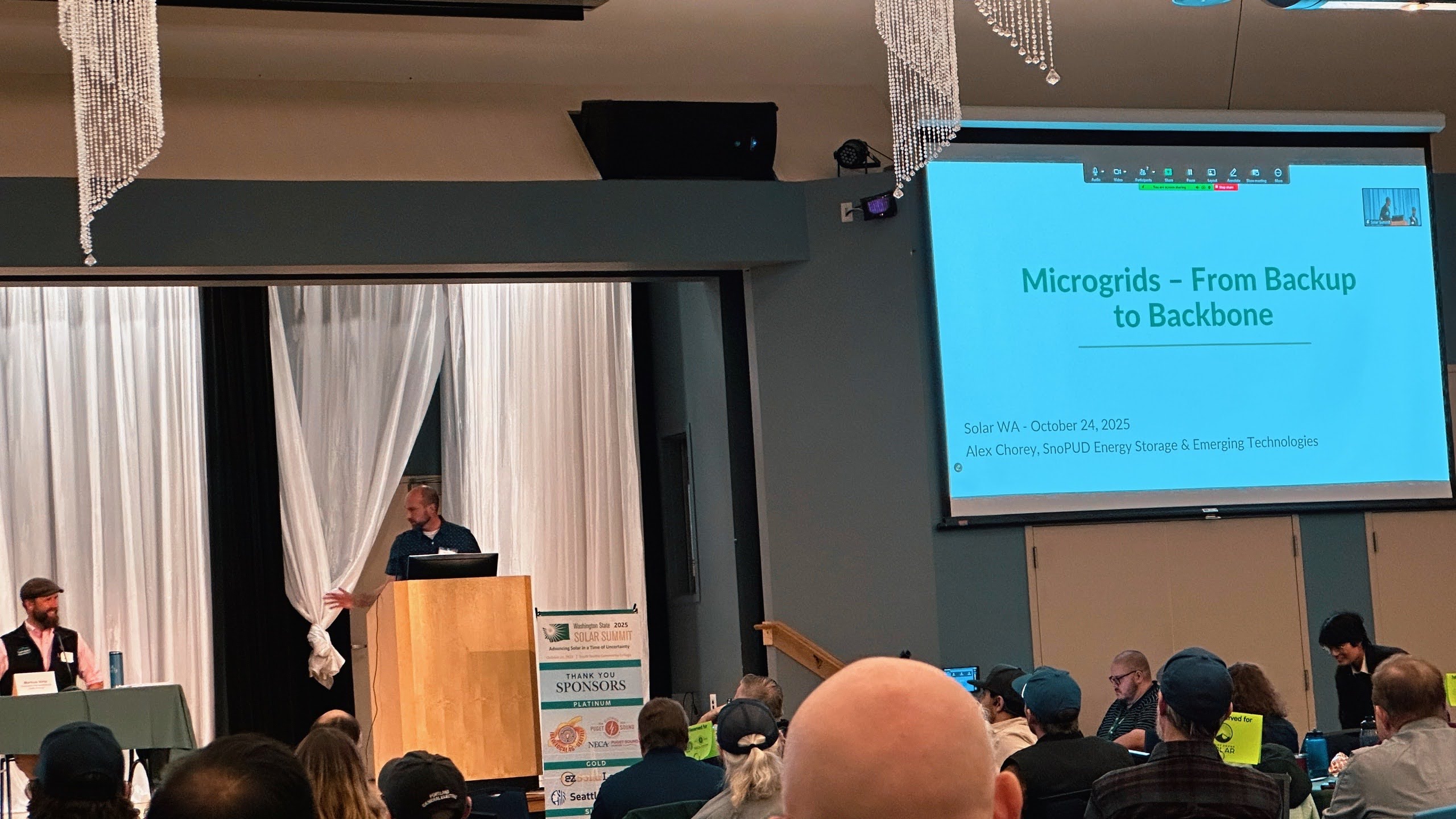
Microgrids Shift from Emergency-Only to Resilience and Modernization
At the Solar Washington Solar Summit on 24 October, a panel of experts explored how microgrids can shift from being emergency-only assets to core tools for delivering community resilience and grid modernization. Four expert panelists examined how utilities, regulators and developers are beginning to grapple with valuing resilience and what’s needed to scale equitable, affordable and reliable microgrid deployment.
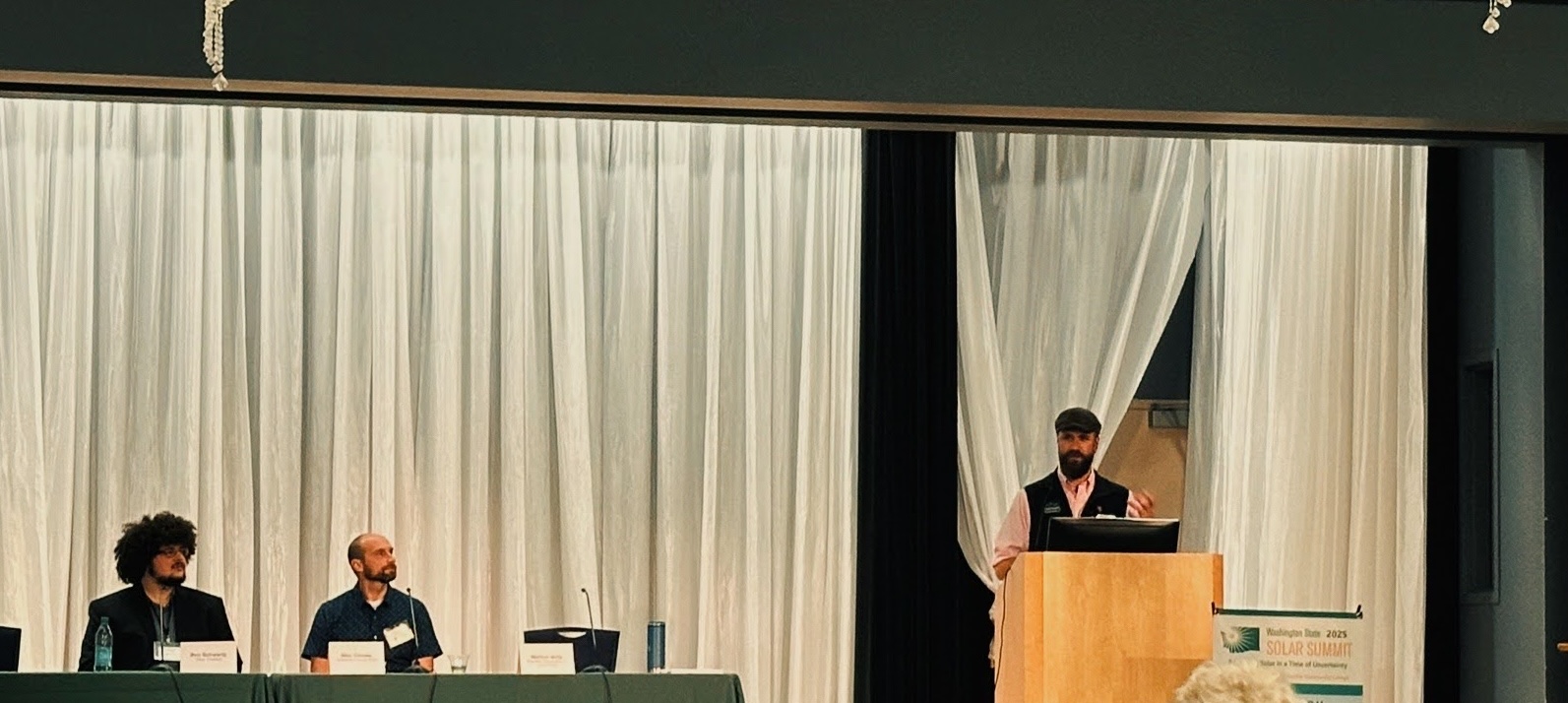
Markus Virta, Cascadia Renewables
Kicking off the session, Markus said we are in a moment of load growth nationally at historic rates, brought on by data center proliferation, electrification of transport, and electrification of industrial and commercial loads.
The Pacific Northwest Utilities Conference Committee (PNUCC) tabulates the integrated resource plans from utilities in the Pacific Northwest, he explained. “Last year, it looked like we would be transitioning to a primary summer peaking requirement to our transmission and distribution systems in 2045. Now, it looks like that could happen as soon as 2035. We will go from traditional winter peaking demand to dual peaking, with peak demand in the summer.”
Additionally, transmission and distribution systems are more stressed. A Bonneville Power Administration (BPA) analysis found that no new transmission capacity is likely across the Cascade crest until 2035. “As a region, we've traditionally generated electricity east of the Cascades and consumed it in the west. Washington State has been a net exporter of energy. That changed for the first time this year, and we are now an importer of energy. Climate impacts are layering on a level of chaos to our physical infrastructure that makes it harder to plan and operate,” Markus said.
Utility operators need to have a reserve margin so they can supply power when consumers flip on a switch. However, “we are retiring assets and not building new generating assets fast enough to meet demand. If we don't have firm capacity from our systems or energy storage co-located with solar, we're not going to be able to resolve this problem.”
A microgrid, Markus explained, has a designated controller, distributed energy resources such as solar or geothermal, and a battery system. It gets complicated quickly. “When we start any kind of development activity around a microgrid, it's critical to listen to the community. When we talk about energy reliability, we're talking about the flexibility of the grid to absorb different technologies, generating power at infrequent times, and having the ability to flex during weather events.”
Metrics include the average frequency of outages and the average duration. Resilience does not yet have a valuation framework, Markus noted. “These microgrid projects are intended to deliver resilience to communities. If we don't have a value to monitor, the controller could fail to prioritize resilience. If we value resilience properly, it might mean providing more capacity in the battery system to provide life safety energy to a facility.”
Alex Corey, Engineer, Snohomish County Public Utilities District (PUD)
Alex said his vision of the utility of the future is a world with utility assets, residential and commercial distributed resources, solar, commercial batteries, residential batteries, EVs and connected home appliances. Everything is connected and working together to provide the resilient, reliable, flexible system that could carry us into the future.
Utilities built the infrastructure to tie everything together. Currently, they help communities function together and coordinate with each other. While they serve basic needs, what everybody wants is saving money and confidence that they can keep the lights on. “Once we get past that point, consumers are willing to integrate more complex systems and take advantage of new resources, such as microgrids.”
People who install solar power are saving money, he said. Having the ability to generate their own power also gives people an understanding that they're participating in the grid. “We've moved to the next stage, where solar installations are being paired with residential batteries.” Solar keeps the lights on and adds resiliency when the power goes out. People can be more conscious of how and when they use energy.”
At the same time, utilities are starting to get nervous about capacity challenges in the near future. The increased participation of more people in the grid means they need to offer education, on the customer side and on the utility side, to allow integration of more complex systems.
Once multiple meters and buildings tie in over the distribution grid, it gets more complicated. Snohomish PUD has its Arlington microgrid, which has been running for about four years. It has solar, a one-megawatt battery, grid chargers, and a backup generator. PUD built it to help everyone understand the impacts of dynamic voltage restoration (DVRs). “As technology improves and we have more commercially accessible vehicle-to-home or vehicle-to-grid chargers, we're planning on upgrades to test and see the impacts. Arlington is a great spot to try new stuff such as battery chemistries or interconnection methodologies. As a conservative utility, we don't throw a new thing on the grid without doing extensive testing.”
PUD is coordinating with BPA to experiment with solar smoothing. For someone trying to balance the grid at a certain scale, he said, it gets inconvenient. BPA charges a fee to integrate variable resources. “Since our microgrid has a battery, we can smooth that solar output into manageable one-hour blocks, which makes it easier to use or give back to BPA.”
“Once we've proven how we can use those tools, we can show how we can get voltage support and frequency support as a capacity resource, instead of having to upgrade a feeder or replace a substation transformer or build out a new substation.
PUD still has older equipment on the system. As a result, “our system planners and operators are not quick to accept new equipment. As it gets integrated, we can start using it to our advantage.”
“We've operated in the same way for 100 years,” he added, “and we're hesitant to integrate new technology. A key piece of moving past that is having firm, clear operational agreements for who's responsible under what conditions.”
“Lastly, we're working on assigning a value that works for customers. Larger microgrid projects cost a lot. BPA provides cheap clean hydropower in the four cents a kilowatt hour range, which makes for tough ROI on a lot of projects. My hope is that the resiliency need can move them forward, if utilities can figure out the value on a piece of equipment like a microgrid.”
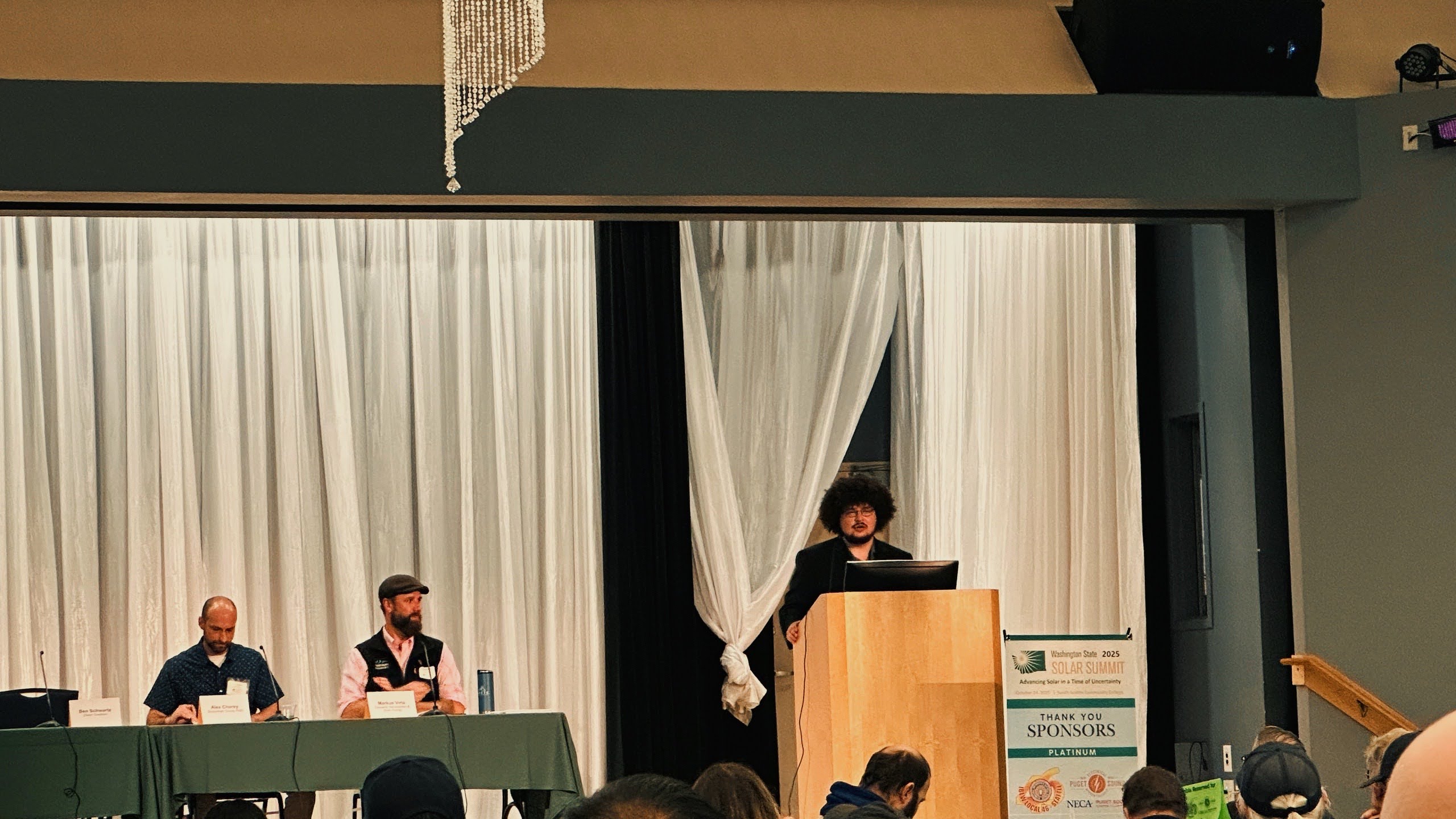
Ben Schwartz, Clean Coalition
Ben said that for any type of facility, such as a grocery store or a fire department, it is important that the lights stay on. “And then you ask, ‘are you willing to pay to keep the lights on’? It's silent. It's never zero, but it's also never something tangible. That's part of the difficulty of working on resilience.”
There are clear metrics for reliability, he said. When it comes to resilience, it is harder. The Clean Coalition has worked on this from the perspectives of an individual facility and a grid.
The Clean Coalition is a nonprofit based in California focused on accelerating the transition to renewable energy. The end goal is 25 percent local energy.
Clean Coalition has developed a methodology called VOR 123 (Value of Resilience 123) for any type in any location. It is designed to help customers understand how much they might be willing to pay to have resilience for their most critical loads. “We found that an average facility should be willing to pay around a 25 percent premium to have indefinite renewables-driven resilience for their most critical loads. Tier 1 is mission critical. It needs 100 percent resilience, though it's only around 10 percent of the load. If you think about a fire department, that would be the dispatch and their water pumps. Tier 2 is 15 percent. If you're a facility like a hospital and provide essential services, that's going to be a higher value of resilience. That impacts the way you size a microgrid, a battery, and your generation system. “
The Clean Coalition has developed a calculator that allows people to input the annual load at a site and gives the size of solar and a battery to keep 25 percent of the load on. It is calibrated for central California.
Clean Coalition has also developed a Resilient Energy Subscription, a fee-based market mechanism that finances community microgrids. Ensuring that the community was able to finance a microgrid was the most effective route to enabling deployment of these systems.
The framework addresses three key areas. “I call it the 3E: establishing the initial footprint of a community microgrid; enhancing it; expanding it.” The concept is that an individual facility will pay a $1 per kilowatt hour fee, on top of an existing rate tariff, guaranteeing delivery of renewable energy during grid outages.
A facility should expect to pay around an additional 1 percent for each percentage of the load backed up. It allows the microgrid owner or operator to recover the cost of service. “We modeled an 8 percent return. The reason we took 8 percent is that it’s around the same or slightly higher than the normal return for a distribution asset, making it appetizing to the utility.”
A good example, he said, is Pacific Gas & Electric (PG&E) in California. PG&E has a remote microgrid program that looks at communities at the end of a distribution line. Typically, a line that goes through a forest or over a mountain is in an area with an extreme fire risk. If the cost of deploying a community microgrid is lower than the cost of upgrading that line, they will go with community microgrid. The reliability of small community microgrids is 99.99 percent, and they've been able to keep renewable energy content above 90 percent.
Allie Detrio, Chief Strategist, Reimagine Power
Allie gave an update on recent policy successes on microgrids in Oregon.
She said microgrids achieve core policy objectives for states, communities and stakeholders - resiliency for backup power, maintaining reliability, decarbonization, meeting climate clean energy goals, driving technology innovation, community empowerment, having communities take control of their energy needs and supporting those who have traditionally been disadvantaged.
In 2021, Oregon passed a bill to create a community Renewable Energy Grant program which supports the planning and construction of new community energy solutions, including resilience. This year, there was almost $65 million available for the program. While it is mainly used for undergrounding, DER and microgrid deployment opportunities are eligible.
Reimagine Power worked with coalition partners in Oregon to create this microgrid policy framework. They started with a two-pronged approach of creating a grant program to focus on community energy resiliency planning and creating a more robust policy regulatory framework for microgrids.
In 2023, Reimagine Power worked on a County Energy Resilience Program. “We were able to put it into the budget. 19 of the 36 counties were able to apply and receive funding, $50,000 for each county. Developing the resources to look into resiliency starts getting coordinated at the local level, the community level, the county level.”
HB 3630, passed in 2023, directed the Oregon Department of Energy to develop a state energy strategy. The first draft, published this past August, outlines opportunities to achieve Oregon's energy goals, including clean energy, affordability, reliability, and resilience.
In 2025, there were three bills. HB 2064 created new guidelines and regulations for community microgrid development. HB 2065 allows third party consultants to conduct microgrid interconnection studies. HB 2066 is the core framework for the next phase of the microgrid policy, directing the Oregon Public Utilities Commission to establish a regulatory framework for the development, ownership and operation of microgrids for third party customers and communities. “We want to have a clear set of rules and guidelines for microgrid development and viable monetization pathways.”
“We are looking at the vision of microgrids in clean energy solutions and policy pathways for communities, at moving into a 21st century grid and modernizing our policy and regulatory systems. We are looking at creating clear regulatory frameworks, developing monetization pathways and value-based compensation mechanisms, and deploying microgrids to promote an interconnected, community-centric, transactive energy future for all.”
The panelists clearly provided a multitude of excellent insights that can support and even guide development of microgrids in Washington State.
Showing 1 reaction