

Use Solar Energy from Your Window or Wall to Power Your House The Growth of Building-Integrated Photovoltaics (BIPV)
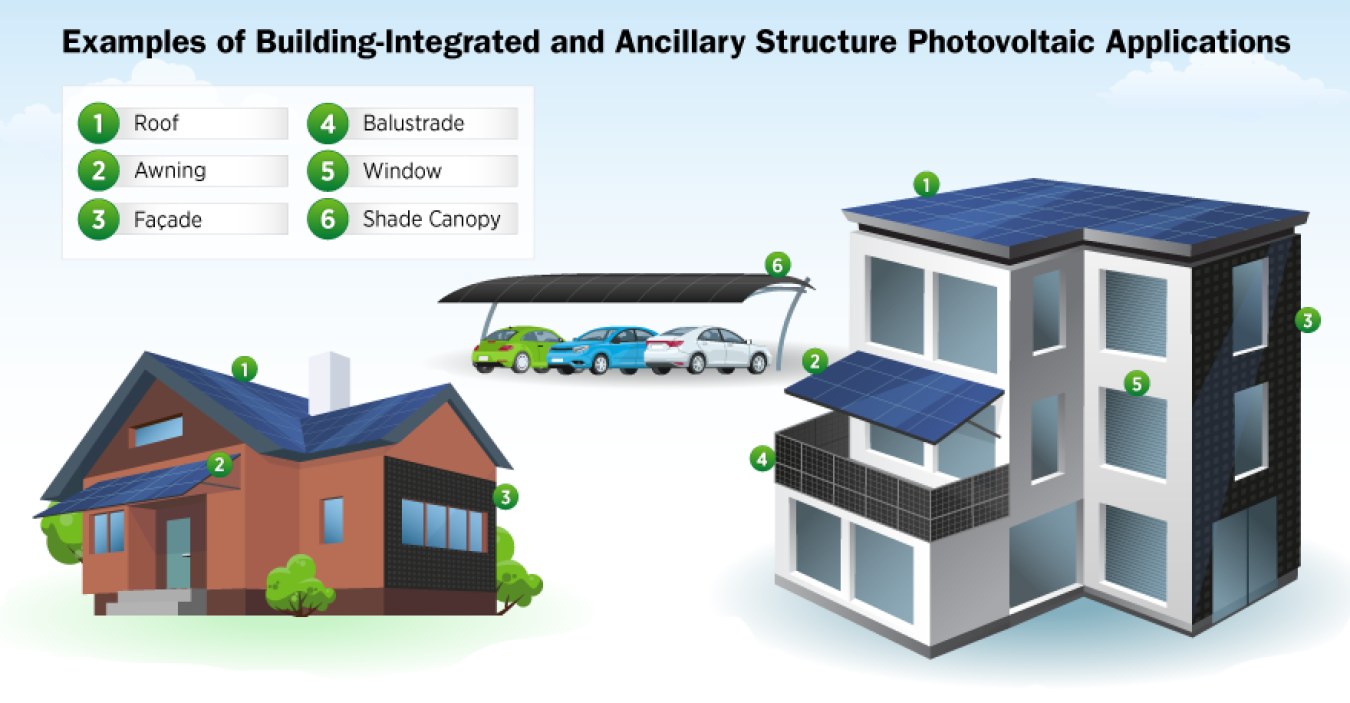 Residential solar systems have traditionally been installed as rooftop panels. Now, however, solar is being integrated into roofs, windows, wall panels and more, enabling new solutions for architects and builders as well as installers.
Building Integrated Photovoltaics (BIPV)
These new solar energy systems, called Building Integrated Photovoltaics (BIPV), are PV elements located within a building's envelope, WBDG explained. They can replace exterior shells such as rooftop solar panel components or be integrated into the building itself. Examples of BIPV materials include glass windows, glass skylights, awnings, canopies, shingles, exterior wall panels and even walkable surfaces. These systems generate electricity and can also add visual interest or aesthetic design elements to a building.
Read more
July 08, 2025
Farming and Solar Power Together Creates a Win-Win for Farmers
As solar farms are increasingly located on farmland, agrivoltaics offers a new pathway of potentially increasing farm output by combining agriculture with solar panels. The benefits could help overcome objections to using agricultural land for solar energy.
What is Agrivoltaics?
Agrivoltaics is a system where solar panels are placed on farmland in a way that farming can continue. There are three main types of systems, the USDA explained: elevated, inter-row, and a combination of the two. Elevated systems place solar panels above vegetation, usually at least 6 feet, so they can protect vegetation from extreme weather such as heavy rains or drought and also reduce sun exposure. In inter-row systems, vegetation is grown between rows of solar panels rather than beneath them. Crops usually have more access to direct sunlight than in elevated systems, and rows of panels can be spaced out widely enough to allow tractors to cultivate vegetation in between.
Read more
May 27, 2025
Innovative Energy Storage Solutions Make Solar even more Attractive
One of the challenges of renewable energy is in ensuring consistent and reliable power generation, for example, solar panels cannot generate power during the night. Energy storage can overcome the difficulty by storing excess power for use when renewable energy is not available. Storage is growing rapidly, and innovations can make deployment easier, faster and cheaper.
Read more
April 28, 2025
Washington’s Utility-Scale Solar Generation – Trending Up
 The U.S. Energy Information Administration (EIA) has published its 2024 state-level data for energy generation, and the results show steady growth for utility-scale solar energy in Washington. According to the EIA’s Electricity Data Browser, the net solar generation in 2024 from Washington plants was 436 thousand megawatt hours (MWh). Although still a minor player in electricity generation in Washington, utility-scale solar showed an increase of about 20% over the 2023. The 2024 increase continues a steady climb of utility scale solar in Washington since 2021 when net generation of utility solar topped out at only 50 thousand MwH.

April 03, 2025
Data Centers need Solar Energy
Across the US, tech companies large and small are building data centers to handle generative AI, streaming, social media and myriad other activities that require massive amounts of data. In the past, Washington was a top destination for data centers, but data centers also require tremendous amounts of electricity. While there has been sufficient electricity so far, the scale of the expected growth of data centers and the difficulties with adding more electricity to the grid are reaching a point where there may soon be insufficient power. New solutions are critically needed.
Read more
January 30, 2025
Expanding Solar with Virtual Power Plants, Microgrids and Local Storage
“There is a general consensus that we've got an energy problem coming in Washington State,” Cascadia Renewables co-founder and managing partner Markus Virta said as he started the third session at the 2024 Solar Washington Summit in October.
We are in an incredibly fortunate position in Washington, Markus opined, in that the Columbia River has been a large “battery” system. “The dams provide an incredible source of resilience to this region and outside of this region. But it is terrifying that they're forecasting 44% less snowpack in 2040. What that means is that later into the winter, instead of snow, we're getting rain that is destabilizing hillsides, putting our transmission equipment at risk. Ultimately, it means less generation in late summer from our dams.”
Read more
January 11, 2025
UW Community Solar Economic Impact
This month, the Urban Infrastructure Lab at the University of Washington published an “Economic Impact Analysis of Community Solar Programs for the State of Washington”. The study looks at third-party-owned community solar, i.e.,mostly corporate-owned community solar installations where a third party owns the project (neither the utility nor the customer) and the public is given the ability to subscribe to the solar energy service of the third party through their utility bill. Corporate-owned community solar facilities are often arranged through the lease of land, but rooftop array development is also a possibility. Thus, according to the study, solar growth increases the opportunity for payments from corporate developers and owners of the arrays to landowners of rural, commercial, and industrial property.
Read more
January 11, 2025
Advancing Energy Equity and Justice
One of our most engaging panels at the 2024 Solar Summit in early October was about energy equity and energy justice. Solar Washington board member Charlee Thomson, who works for the Northwest Energy Coalition, organized and moderated the panel. “These two topics, equity and justice, are integral to the clean energy transition and the advancement of solar energy. While we are reaching beyond the typical scope of what folks generally think of as solar energy, we wanted to put solar in the broader context of the clean energy transition.” The panelists, Environmental Justice Council Climate Justice Advisor Jonathan Chen, Spark Northwest Policy Manager John Seng and Climate Solutions Consultant Ali Lee, provided insights for the audience.
Read more
November 08, 2024
Electrify Everything to Save Costs and Decarbonize
“The decarbonization picture is that electricity is more efficient than fossil fuels in many applications, vehicles or cars, as well as heating systems,” Solar Washington board member Charlee Thompson said as she kicked off the panel on “Decarbonization and Electrification” at the 2024 Solar Summit on October 4, 2024. “The electrification piece of the overall decarbonization strategy becomes really, really important.”
Clean Energy Transition Institute (CETI) Research Analyst Ruby Moore-Bloom, McKinstry senior consultant Scott Foreman-Murray and Rewiring America volunteer Wendy Ferry provided insights on how to make electrification happen and how to achieve Washington’s decarbonization goals.
Read more
October 21, 2024
Understanding Solar Tariffs

The solar industry is beginning to experience whiplash due to a recent flurry of regulatory changes, according to the law firm Sheppard Mullin, rendering solar tariffs among the most intricate in the history of U.S. imports. Homeowners are wondering about the extent of the tariffs' cost impact. Surprisingly, the cost may be minimal.
Read more
September 10, 2024